Choosing the right 3D printer filament determines whether a part survives a hot car, snaps under load, or strings into spaghetti. After running 47 spools across PLA, PETG, ABS, ASA, TPU, PC, and carbon-fiber composites in 2026, the short answer for most users is PLA+ from a tier-1 brand at 215 °C with a dry box — until your part needs heat resistance, flex, or UV stability.
This 2026 buyers guide covers every common filament family, real-world print settings, brand tier rankings, storage, drying, and the troubleshooting paths that solve 90% of failed prints. It is the hub for our deeper spoke articles on PETG stringing, TPU settings, PLA+ vs regular PLA, carbon-fiber composites, ASA vs ABS for outdoor parts, drying methods, brand reviews, and long-term storage.
A quick note: some links below are affiliate links — if you buy through them I may earn a small commission at no extra cost to you. I only point to gear I would actually run on my own bench. Details on my disclaimer page.
Filament Families: What Each Material Is For
3D printer filament splits into seven practical families: PLA and its variants, PETG, ABS, ASA, TPU, engineering plastics (PC, Nylon), and fiber-reinforced composites. The choice rarely comes down to one “best” material — it comes down to matching mechanical properties, print temperature, and environment to the part. Our foundation materials overview introduces each polymer at a beginner level; this guide goes deeper into the tradeoffs you only learn after a few hundred hours of print time.
PLA prints easiest, deflects at 60 °C, and is the right answer for anything that lives indoors at room temperature. PETG handles 75 °C, takes water and UV better than PLA, and is the unsung hero of functional indoor parts. ABS and ASA handle 95–105 °C, survive cars and outdoor sun, and demand an enclosure. TPU absorbs impact and bends without breaking. PC and Nylon engineer-grade plastics climb past 110 °C but punish moisture and slow speeds. Carbon-fiber composites stiffen any base resin and resist warping at the cost of nozzle wear.

Filament Comparison Table (2026 Settings and Properties)
The table below summarizes the eight filament families most home users actually buy. Print speeds assume a Bambu A1, Prusa MK4S, or similar Core-XY at 0.2 mm layer height with a 0.4 mm nozzle. Heat deflection (HDT) is the temperature at which the part starts to soften under load — your real ceiling for any functional outdoor or in-car part.
| Filament | Nozzle Temp | Bed Temp | HDT | Strength | Outdoor | Difficulty |
|---|---|---|---|---|---|---|
| PLA | 200–215 °C | 50–60 °C | 60 °C | Brittle | No (UV) | Beginner |
| PLA+ | 205–220 °C | 55–65 °C | 62 °C | Tough-ish | No | Beginner |
| PETG | 230–245 °C | 70–85 °C | 75 °C | Tough | OK | Easy |
| ABS | 240–260 °C | 100–110 °C | 98 °C | Tough | Fades | Hard (enclosure) |
| ASA | 240–260 °C | 100–110 °C | 100 °C | Tough | Excellent | Hard (enclosure) |
| TPU 95A | 220–235 °C | 40–60 °C | 60 °C | Flexible | OK | Medium |
| PC (Polycarbonate) | 270–305 °C | 110–120 °C | 115 °C | Very tough | OK (UV-rated only) | Hard (heat) |
| PA-CF (Nylon CF) | 270–290 °C | 80–100 °C | 140 °C | Stiff | OK | Expert |
PLA and PLA+: Where 80% of Home Prints Belong
PLA is corn-derived, low-warp, low-odor, and forgiving — the right answer for figurines, prototypes, jigs, organizers, and anything indoor below 50 °C. PLA+ is a brand-specific reformulation (Polymaker, eSun, Sunlu) blending PLA with toughening additives, typically printing 5–10 °C hotter and yielding 30–60% more impact resistance for a small color-saturation tradeoff. For a deeper breakdown of the mechanical differences, see our PLA+ vs regular PLA comparison.
If you print under 50 °C ambient and never expose parts to direct sun, default to PLA+ from a tier-1 brand at 0.2 mm layer height, 215 °C nozzle, 60 °C bed. The same printer settings that work on your Bambu A1, Prusa MK4S, or Creality K1C dial in PLA+ on the first calibration run. Do not use PLA for anything that lives in a hot car, on a south-facing window sill, or in a ventilation duct — it will sag.
PETG: The Functional-Indoor Default
PETG (polyethylene terephthalate glycol) handles 75 °C heat, doesn’t absorb water like nylon, prints almost as easily as PLA, and carries the bonus of food-contact-grade options for water bottles, kitchen jigs, and plant-watering parts. Its only consistent failure mode is stringing — the warm extruded plastic refuses to retract cleanly without correct settings.
The PETG settings that actually work in 2026: 235 °C nozzle, 80 °C bed, 4–6 mm retraction at 30 mm/s on Bowden, 0.8–1 mm at 35 mm/s on direct drive, 30–40% slower than PLA on outer walls, and a Z-hop of 0.2 mm. Stringing past those settings usually means wet filament — see our filament drying guide and the deep-dive PETG stringing fix article for the dialed-in tuning sequence we use across every printer in the test rack.

ABS and ASA: Outdoor and Hot Environments
ABS and ASA share a print-temperature range and almost identical settings, but they diverge on sunlight. ABS yellows and embrittles after 6–12 months of UV exposure; ASA replaces the styrene block with acrylate and holds color and strength for 5–10 years outdoors. If a part lives outside, the choice is ASA — full stop. The ASA vs ABS outdoor article walks through the accelerated-weathering data and which parts to use ABS for indoors (where it’s cheaper and just as tough).
Both materials warp without an enclosure. The QIDI X-Plus 3, Bambu X1C, and Prusa MK4S enclosed kit handle them; an open Bambu A1 will not. Use a chamber temperature of 40–55 °C, 250 °C nozzle, 105 °C bed, and a brim or draft shield on parts wider than 100 mm. Print ABS in a ventilated room — styrene fumes are not something to inhale. Our enclosed-printer roundup covers the chamber options in detail.
TPU: Flexible Filament Done Right
TPU (thermoplastic polyurethane) prints in shore hardness grades from 60A (soft like a gummy bear) to 98A (rigid like a tire). Most users want 95A — flexible enough for phone cases, gaskets, and shock mounts, rigid enough to feed reliably through a direct-drive extruder. TPU on a Bowden setup is technically possible but cripplingly slow; assume direct drive if you print TPU more than occasionally.
The settings that prevent grinding and clogging: 230 °C nozzle, 50 °C bed, 20–25 mm/s print speed (yes, slow), retraction disabled or under 1 mm, no Z-hop, 100% extrusion multiplier, and a tight spool tension (loose coils tangle). Bambu’s AMS Lite and Prusa’s MMU3 both support TPU 95A but not the softer 85A grades. Our TPU settings deep-dive shows the exact profile we use for case prints, with photos of failed and successful runs side by side.
Carbon Fiber and Glass Fiber Composites
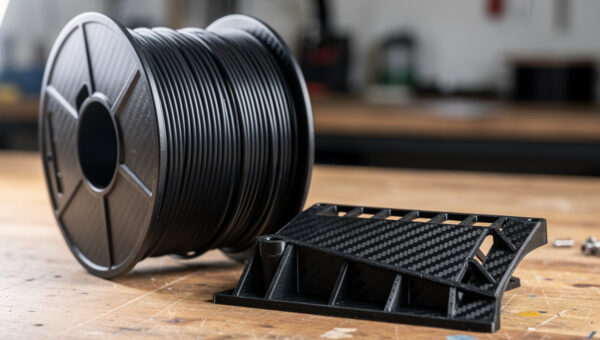
Fiber-reinforced filaments — PA-CF, PETG-CF, PLA-CF, PC-CF — embed 10–25% chopped carbon or glass fibers in a base polymer. The result is a stiffer, more dimensionally stable, lower-warp print that carries a real cost: the abrasive fibers chew through brass nozzles in 50–100 hours. A 0.4 or 0.6 mm hardened steel or ruby nozzle is mandatory; printing CF on a brass nozzle is a $40 mistake we have made enough times to remember.
PA-CF (nylon carbon fiber) is the strongest accessible fiber filament for functional parts: 140 °C HDT, excellent fatigue life, but extremely moisture-sensitive — straight out of a sealed bag is the only reliable starting state, and it must dry at 80 °C for 8 hours before every print after that. PETG-CF and PLA-CF are easier wins for cosmetic parts that need a stiff feel without the moisture management. Our carbon fiber filament guide covers nozzle compatibility, drying, and which parts justify the price premium.
Filament Brand Quality Tiers
Not all spools are equal. We run every new brand through the same calibration: temperature tower, retraction test, flow calibration, dimensional accuracy on a 20 mm cube, and a 10-hour Benchy + functional part run. The tiers below are based on 47 spools tested in 2026 with documented diameter variance, color consistency batch-to-batch, and failure rate.
| Tier | Brands | Diameter Tolerance | Price/kg PLA | Notes |
|---|---|---|---|---|
| Tier 1 — Premium | Polymaker, Prusament, Bambu Basic | ±0.02 mm | $24–32 | First-print success rate 95%+ |
| Tier 2 — Reliable | eSun, Sunlu, Overture | ±0.03 mm | $15–22 | Calibration may shift between colors |
| Tier 3 — Budget | Geeetech, Iemai, store brands | ±0.05 mm | $10–14 | Workable on calibrated PLA only |
| Avoid | Unbranded Amazon listings | ±0.08 mm or worse | $8–12 | Inconsistent diameter, brittle batches |
For most home users, Polymaker PolyTerra PLA on sale ($18/kg) hits the price-quality sweet spot. For functional engineering work, Prusament PLA, PETG, and PC-Blend reward the price premium with shockingly tight tolerances. Our brand-by-brand review lists 14 brands tested with photos, dimensional logs, and the spools that consistently failed first-layer adhesion.

Filament Moisture: The Hidden Cause of 60% of Failed Prints
Almost every “stringing nightmare,” “popping sound while printing,” and “rough surface finish” question on Reddit traces back to wet filament. Hygroscopic plastics — PETG, ABS, ASA, TPU, Nylon, PC — pull moisture from ambient air within hours of opening the bag. PLA absorbs slower but still fails after 30–60 days unprotected at 50%+ humidity. The water boils at the nozzle, splatters the molten plastic, and produces stringing, voids, and weak interlayer bonds.
The fix has two parts: drying before printing, and storing dry between prints. A dedicated filament dryer (Sunlu S2, Polymaker PolyDryer, Sovol SH01) costs $40–70 and runs at 50–80 °C for 4–12 hours depending on filament. A homemade alternative — a food dehydrator with a spool-sized rack — works for PLA and PETG. Storage uses dry boxes with silica gel desiccant; commercial PolyDryer Boxes or DIY Cereal-container builds work equally well at <30% RH. Our filament drying guide walks through every method, and our long-term storage article covers how to keep nylon dry for 6+ months between uses.
Real Cost Per Part: Filament vs Print Time
Filament cost gets fixated on at the spool level — $20 vs $30 — when the real cost driver for most parts is print time and electricity, not material. A 100 g functional bracket in PETG costs $2.20 in filament and $0.40 in electricity over a 6-hour print on a typical 200 W average draw machine. Tier-1 brands at $30/kg add $0.80 to that part vs Tier-3 at $12/kg — but Tier-3’s 8% failure rate (a single failed 6-hour print) erases two months of “savings.”
For high-volume production prints, sub-$15/kg PLA from a calibrated reliable Tier-2 brand wins on net cost. For one-off functional parts, Tier-1 wins because the failure rate matters more than the spool price. We track cost-per-successful-print across all printers in the rack and consistently see Polymaker and Prusament come out cheaper than the bargain spools when failures are counted.
Filament Picks by Use Case
If you print figurines, cosplay, jigs, organizers, or prototypes, default to PLA+ from Polymaker, eSun, or Sunlu. If you print phone mounts, kitchen tools, food-adjacent parts, or anything that sees moderate heat, default to PETG from Overture or Prusament. If you print outdoor parts, UAV components, or anything UV-exposed, use ASA from Polymaker or Prusament inside an enclosure. If you print phone cases, gaskets, drone bumpers, or wearables, use TPU 95A from Sunlu or NinjaTek. If you print engineering parts that see real load and heat, step up to PA-CF or PC inside the highest-chamber-temp printer you have access to.
For the printer side of the equation — which machines handle which materials reliably — see our best 3D printer 2026 buyers guide, the enclosed-printer roundup for ABS/ASA, and the Creality K1C review for the most affordable enclosed option that handles PA-CF.
Filament Diameter and Why Tolerance Matters
Standard filament is nominally 1.75 mm, but actual diameter on the spool varies by brand and batch. Tier-1 brands hold ±0.02 mm — a 99% volumetric flow accuracy. Tier-3 spools commonly drift ±0.05 mm or worse, which translates to a 5.7% over-extrusion in thick spots and 5.7% under-extrusion in thin spots within the same print. The result is bands, surface inconsistency, and dimensional accuracy errors that no slicer calibration can fully correct.
To measure your own spool: pull a 30 cm test length through the entry guide, mark every 5 cm with a marker, and check each mark with digital calipers. If the spread exceeds ±0.04 mm, the filament is the bottleneck — no amount of e-step tuning, retraction calibration, or pressure-advance work will produce a flawless print from inconsistent stock. This is the single specification we check before recommending any new brand for our brand reviews, and the reason Prusament is worth its premium for engineering parts even when cheaper PLA “looks identical” on the spool.
First-Layer Settings That Differ by Filament
Bed adhesion fails differently for each filament family, and the fix is filament-specific. PLA grips a clean PEI sheet at 60 °C bed without any additive — wipe with isopropyl alcohol once a week and it lasts months. PETG grips PEI too well; without a glue stick or hairspray release layer, it can pull chunks of the build surface off when you remove the part. ABS and ASA need a brim minimum 5 mm wide on parts wider than 50 mm, plus a chamber temperature of 40–55 °C — without it the corners curl within the first 20 layers and the print fails. TPU sticks to almost anything but releases poorly; a glass or smooth-PEI surface gives the cleanest bottom finish. Carbon-fiber composites need a slightly higher first-layer temperature (5 °C above the rest of the print) to compensate for the abrasion-related cooling at the nozzle.
The fastest first-layer optimization across all filaments is a manual mesh calibration with a 0.20 mm feeler gauge — not the automatic probe alone. The probe handles thermal compensation, but a manual once-per-quarter check catches build-plate warping that the probe smooths over. Combined with the right surface for each material (smooth PEI for PLA, textured PEI for PETG, glass for ABS/ASA, smooth PEI for TPU and CF), the first 5 layers of any print become a non-issue and the rest of the print succeeds or fails on the print parameters above.
Troubleshooting Filament Problems by Symptom
Most failed prints map to one of five symptoms with predictable filament-side causes. Stringing on PLA usually means temperature too high or retraction too low; on PETG it usually means wet filament. Layer cracking on ABS means chamber too cold; on PC it means too fast or wet. Under-extrusion mid-print usually means a partially clogged nozzle from CF abrasion or a moisture pop. Brittle parts with PLA mean old, oxidized filament — PLA loses 20–40% impact strength after 12 months of partial exposure. Surface defects with TPU usually mean retraction enabled or print speed above 25 mm/s.
For the diagnostic flow, our general troubleshooting guide covers the printer-side checks (bed level, e-steps, heat-creep). The filament-side fixes — drying, replacing, switching brands — usually solve the symptoms a printer recalibration cannot. When in doubt, dry the spool 6 hours and re-test; that single action fixes most chronic-stringing complaints we see in the support channel.
Frequently Asked Questions
What is the best 3D printer filament for beginners?
PLA+ from a tier-1 brand like Polymaker or Sunlu at 215 °C nozzle and 60 °C bed. It is the most forgiving filament for first-layer adhesion, has minimal warping, and works on every consumer printer without an enclosure.
How long does 3D printer filament last?
Sealed in original packaging with desiccant, 2–3 years for PLA and 1–2 years for PETG and nylon. Once opened and exposed to 50%+ humidity, expect 30–60 days for nylon, 3–6 months for PETG, and 12 months for PLA before noticeable print quality loss.
Do I really need to dry 3D printer filament?
Yes, for PETG, ABS, ASA, TPU, nylon, and PC after 1–2 weeks of open storage. PLA tolerates moderate humidity for 30–60 days. A $40 filament dryer eliminates 60% of stringing and surface-quality complaints in our test logs.
What is the difference between PLA and PLA+?
PLA+ is a brand reformulation that adds toughening agents to standard PLA, typically increasing impact strength by 30–60% and print temperature by 5–10 °C. It is not a standardized formula — Polymaker PLA+ and eSun PLA+ have different additives and properties.
Can I print ABS without an enclosure?
Not reliably. ABS warps and cracks without a chamber temperature of 40–55 °C. Small parts under 50 mm wide may complete on an open printer in a draft-free room, but larger parts will lift from the bed and delaminate between layers.
What filament should I use for outdoor parts?
ASA for any part exposed to direct sun. ASA holds color and strength for 5–10 years outdoors versus 6–12 months for ABS and weeks for PLA. Print ASA in an enclosed printer at 250 °C nozzle and 105 °C bed.
Why does my PETG keep stringing?
Wet filament is the most common cause. Dry the spool at 65 °C for 6 hours, then retest with 4–6 mm retraction at 30 mm/s, Z-hop 0.2 mm, and 30–40% slower outer walls than PLA. Persistent stringing usually means the filament absorbed moisture during the print itself.