Why Material Selection Matters More Than Printer Choice
The material you feed into your 3D printer fundamentally determines the mechanical properties, appearance, printability, and applications of your finished parts. A $3,000 printer printing cheap PLA produces weak, heat-sensitive objects unsuitable for functional applications. Conversely, a basic $300 printer with proper material selection creates durable components that withstand real-world stresses. Understanding materials transforms printing from a novelty into a genuine manufacturing capability.
This guide examines the five essential material categories every 3D printer operator should master: PLA, PETG, ABS, TPU, and specialty composites. We explore print temperatures, mechanical properties, post-processing requirements, and safety considerations. By understanding these materials deeply, you will select the right plastic for each application rather than defaulting to whatever filament happens to be loaded.
PLA: The Gateway Material That Deserves Respect
Polylactic Acid, commonly called PLA, serves as the default material for good reasons. Derived from renewable resources like corn starch, PLA prints at relatively low temperatures (190-220°C), requires minimal bed heating (50-70°C or even unheated), produces minimal odor, and offers excellent dimensional accuracy with minimal warping. For beginners learning printer operation and basic design principles, PLA provides the most forgiving learning curve.
Understanding PLA’s Properties
PLA possesses high stiffness and excellent detail reproduction, making it ideal for dimensional prototypes, artistic prints, and educational models. The material exhibits low shrinkage during cooling, preventing the warping and layer separation issues that plague more demanding materials. Surface quality tends toward matte or semi-gloss finishes depending on print temperature and cooling, accepting paint and primer well for finished aesthetics.
However, PLA’s glass transition temperature around 55-60°C creates significant limitations. Parts left in hot cars, exposed to direct sunlight, or used near heat sources deform permanently. The material also exhibits brittle failure modes rather than the ductile deformation seen in tougher plastics. Impact resistance is poor; dropped PLA parts often crack or shatter where ABS or PETG would survive.
PLA Variants and Special Formulations
Standard PLA represents just the beginning. PLA+ or Tough PLA formulations incorporate additives that increase impact resistance and layer adhesion, creating functional parts approaching PETG durability while retaining PLA’s printability. Matte PLA produces velvety, non-reflective surfaces ideal for artistic prints. Silk PLA contains additives creating metallic or pearlescent finishes without post-processing. Wood-filled PLA incorporates wood fibers for unique aesthetics, though these abrasive composites require hardened nozzles.
Color availability in PLA is unmatched by other materials. Manufacturers offer standard colors, metallics, neons, pastels, color-changing filaments, and glow-in-the-dark variants. This variety makes PLA the material of choice for decorative and artistic applications where appearance matters as much as function.
PETG: The Sweet Spot Between Ease and Performance
Polyethylene Terephthalate Glycol has emerged as the favorite material among experienced hobbyists who need functional parts without ABS printing headaches. PETG combines excellent layer adhesion, chemical resistance, and impact toughness with printability approaching PLA’s ease. It bridges the gap between decorative PLA prints and demanding engineering applications.
PETG Printing Characteristics
PETG prints at 230-250°C with heated beds at 70-85°C. The material bonds aggressively to print surfaces—often too aggressively. Without proper bed preparation (typically glue stick or hairspray on glass), PETG can permanently fuse to build plates. Once you master bed adhesion management, PETG offers reliable printing with minimal warping and excellent layer bonding that creates strong, isotropic parts.
Cooling requirements differ significantly from PLA. PETG prefers minimal cooling (30-50% fan speed) to allow layers to bond properly. Excessive cooling creates weak layer adhesion and brittle parts. This thermal behavior necessitates different slicer profiles than PLA, though modern slicers increasingly include optimized PETG presets.
Mechanical Properties and Applications
PETG offers tensile strength comparable to ABS (50-60 MPa) with superior impact resistance and layer adhesion. The material resists water, acids, bases, and organic solvents better than PLA or ABS, making it suitable for containers, laboratory equipment, and outdoor applications. Impact strength exceeds PLA by 300-500%, creating parts that survive drops, bumps, and flexing without cracking.
Common PETG applications include mechanical enclosures, brackets and structural components, water-tight containers, outdoor signage, protective guards, and parts requiring chemical resistance. The material’s transparency (in clear formulations) enables light pipes and diffusion applications impossible with opaque materials.
ABS: The Original Engineering Material
Acrylonitrile Butadiene Styrene dominated early desktop 3D printing as the only material offering heat resistance and mechanical strength. Despite being supplanted by easier-to-print alternatives in many applications, ABS retains unique advantages for specific use cases, particularly post-processing through vapor smoothing and applications requiring maximum heat resistance among common filaments.
ABS Printing Challenges
ABS prints at 240-260°C with bed temperatures of 90-110°C. The material demands enclosed build chambers to prevent drafts that cause warping, layer separation, and cracking. Even with enclosures, large ABS prints often require careful bed adhesion strategies including ABS juice (dissolved ABS in acetone) or specialized build surfaces. The fumes produced during printing require ventilation; ABS releases styrene, a known irritant and potential carcinogen with chronic exposure.
These requirements make ABS challenging for beginners. Failed prints are common during the learning process. However, mastering ABS printing demonstrates genuine 3D printing competence and opens applications impossible with easier materials.
ABS Advantages and Applications
ABS offers heat resistance to approximately 100°C, significantly exceeding PLA’s 55°C limit. The material withstands automotive interior temperatures, dishwasher cycles, and heat-exposed applications that destroy PLA parts. Mechanical properties include good impact resistance, reasonable tensile strength (40-50 MPa), and the ability to flex slightly before breaking rather than shattering.
The defining ABS advantage is acetone vapor smoothing. Exposing ABS prints to acetone vapor dissolves surface layer lines, creating injection-mold-quality glossy finishes impossible through sanding alone. This capability makes ABS essential for cosplay props, automotive interior pieces, and aesthetic applications requiring professional appearance.
ASA: ABS Without the Headaches
Acrylonitrile Styrene Acrylate offers nearly identical mechanical properties to ABS with significantly improved UV resistance and reduced warping tendency. ASA prints at similar temperatures (240-260°C) and requires heated beds (90-110°C) but tolerates less aggressive enclosure requirements. The material resists yellowing and degradation from sun exposure, making it ideal for outdoor applications.
For users considering ABS, ASA often provides better results with fewer printing challenges. The primary disadvantage is cost—ASA typically costs 20-40% more than ABS and offers fewer color options. However, the reduced printing frustration and superior weather resistance justify the premium for many applications.
TPU and Flexible Materials
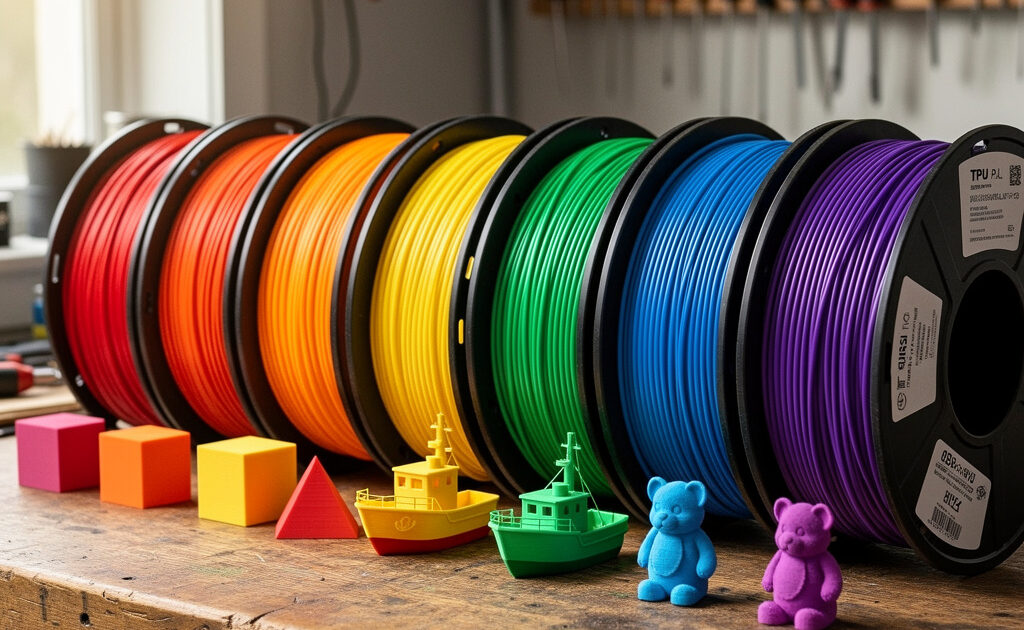
Thermoplastic Polyurethane creates rubber-like parts with Shore hardness ratings from 85A (soft, squishy) to 95A (firm, gasket-like). These flexible filaments enable vibration dampeners, phone cases, gaskets, seals, wheels, and living hinges impossible with rigid materials. However, printing flexible materials presents unique challenges requiring specific hardware configurations.
Printing with Flexible Filaments
Flexible filament compresses and buckles under pressure if the extruder path allows any room for the filament to flex. Bowden tube systems longer than a few centimeters typically fail with soft TPU grades. Direct drive extruders with short filament paths (under 50mm) handle flexible materials significantly better. Print speeds must decrease to 20-40mm/s to prevent compression in the hot end.
Retraction settings require careful tuning. Excessive retraction causes flexible filament to compress and jam; insufficient retraction produces stringing. Typical retraction distances are 1-2mm at 20-25mm/s for direct drive systems. Cooling requirements vary by hardness—softer TPU benefits from active cooling while firmer grades print well with standard profiles.
TPU Properties and Applications
TPU offers excellent abrasion resistance, chemical resistance, and the ability to stretch and return to shape repeatedly. Shore 95A TPU creates functional parts like drone landing gear and protective bumpers. Softer 85A grades produce truly flexible items like phone grips and watch bands. The material bonds aggressively to build surfaces, often requiring glue stick barriers to prevent permanent adhesion.
Nylon: The Premium Engineering Material
Nylon (polyamide) represents the pinnacle of common FDM materials, offering exceptional strength, toughness, chemical resistance, and low friction coefficient. Nylon parts survive impacts, abrasion, and stress that destroy other materials. However, nylon printing demands significant preparation and environmental control.
Nylon Printing Requirements
Nylon absorbs atmospheric moisture aggressively, requiring dry storage and often pre-drying before printing. Wet nylon produces steam bubbles, popping sounds, and weak, porous parts. Print temperatures range from 240-280°C depending on specific formulation (PA6, PA66, PA12). Heated beds at 70-100°C help adhesion but nylon bonds poorly to most surfaces without specialized build plates or adhesives. A food dehydrator is a budget-friendly way to dry nylon before printing — the food dehydrator for filament drying guide covers which models fit large spools and the temperature settings that work without warping the plastic.
All-metal hot ends are mandatory—PTFE-lined hot ends degrade at nylon printing temperatures. Enclosures help but are less critical than with ABS because nylon’s crystallization process differs from ABS’s thermal contraction. Garolite (G10/FR4) build surfaces provide the best bed adhesion for nylon, though glue stick on glass works acceptably.
Carbon Fiber and Glass-Filled Composites
Composite filaments incorporating chopped carbon fiber, glass fiber, or other reinforcements offer increased stiffness, dimensional stability, and heat resistance. These materials print similarly to their base plastics (usually nylon, ABS, or PETG) but require hardened nozzles because the fibers abrade brass rapidly. Stainless steel or ruby-tipped nozzles resist this abrasion.
Carbon fiber nylon produces parts with stiffness approaching aluminum and significantly improved heat resistance over unfilled nylon. The material is ideal for structural components, automotive parts, and applications requiring maximum rigidity. Glass fiber composites offer similar benefits at lower cost but with more visible layer lines and slightly reduced impact resistance.
Resin Materials: The SLA/MSLA Ecosystem
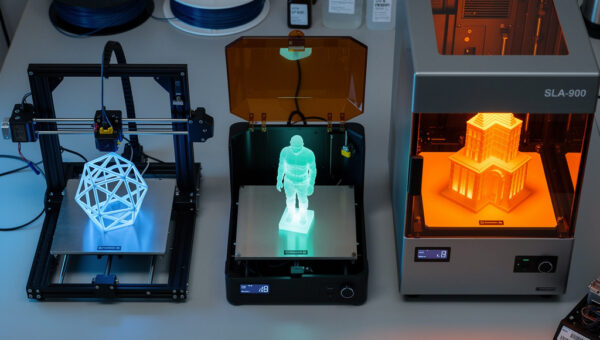
Resin printing materials differ fundamentally from filament-based FDM materials. Liquid photopolymer resins cure into solid plastic when exposed to UV light, enabling detail and surface quality impossible with extrusion printing. Understanding resin categories helps match materials to applications.
Standard and Engineering Resins
Standard resins offer good detail reproduction, reasonable strength, and minimal post-processing requirements. They suit general prototyping, display models, and applications where appearance matters more than mechanical performance. Engineering resins mimic ABS, polypropylene, or polycarbonate properties, offering improved impact resistance, heat tolerance, or flexibility.
Specialized Resin Formulations
Castable resins burn out cleanly without ash residue, enabling jewelry casting and metal investment casting workflows. Dental and biocompatible resins meet regulatory requirements for medical applications, though users must verify specific certifications for their jurisdiction. Flexible and tough resins create rubber-like parts comparable to injection-molded TPU, though typically with less elongation.
Material Selection Decision Matrix
Choosing the right material requires balancing multiple factors: print difficulty, mechanical requirements, environmental conditions, post-processing needs, and cost. PLA excels for learning, prototypes, and decorative prints. PETG serves most functional applications requiring durability without extreme heat or chemical resistance. ABS and ASA handle heat and enable vapor smoothing. TPU provides flexibility. Nylon offers maximum mechanical performance for demanding applications. Resin materials achieve detail impossible with filament printing.
With material understanding established, the next article in this series guides you through the complete printing workflow—from finding or designing models, through slicing software configuration, to successful print completion. Understanding materials enables you to select appropriate settings during that workflow rather than using generic profiles that ignore material-specific requirements.
]]>Put Your Material Knowledge to Work
Now that you understand materials, learn the complete 3D printing workflow from design to finished part. Or explore post-processing techniques to achieve professional-quality finishes.