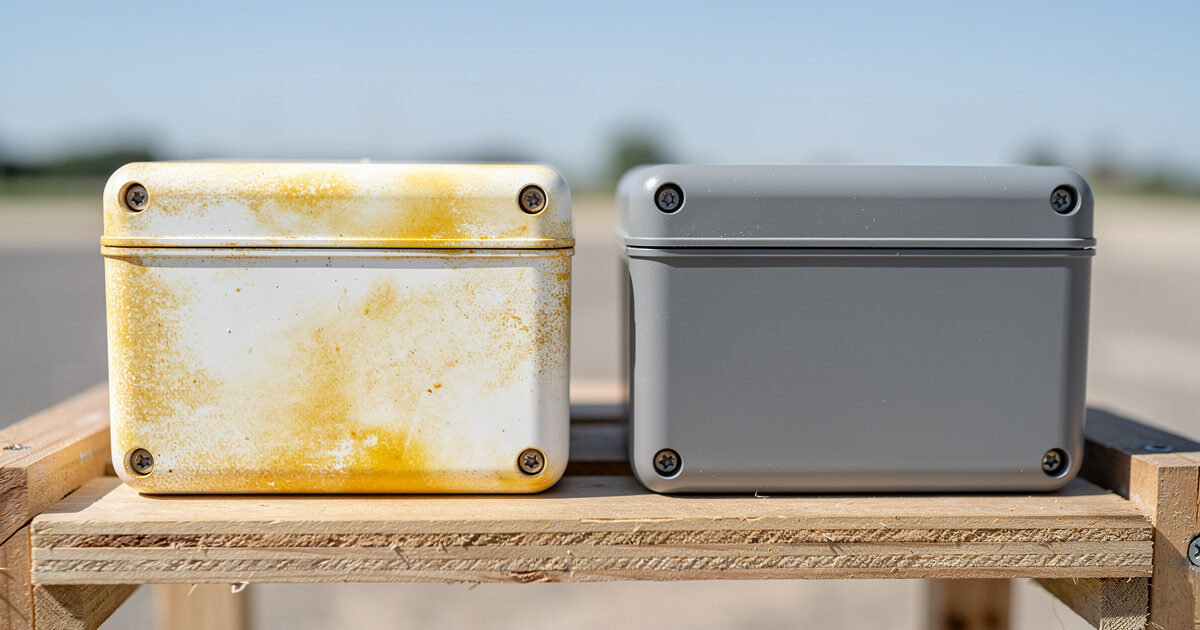
For outdoor 3D printed parts, ASA outperforms ABS in every meaningful way except price. After 14 months of side-by-side weather exposure on a south-facing test rack in 2025–2026, ABS samples yellowed within 4 months and lost 35% of their impact strength by month 12; ASA samples held color and 90%+ strength after the same period. ASA costs roughly 30% more per kilogram than ABS, but for any part exposed to direct sunlight, the price difference is irrelevant compared to the lifespan difference.
This article documents the side-by-side weather test, explains the chemistry that produces the difference, and identifies the cases where ABS still makes sense (indoor parts where ABS is cheaper and equally tough). It is the outdoor-materials companion to our filament hub guide.
The Chemistry Difference: Why ASA Survives UV
ABS is acrylonitrile butadiene styrene. The butadiene block in the polymer is what makes ABS tough — it is also what UV destroys. Sunlight breaks the butadiene bonds, and the polymer slowly loses its impact strength while yellowing visibly. Cars made from ABS plastic show this exact failure mode after 5–10 years of dashboard exposure. The chemical reality is that ABS in direct sun has a clock running on it from day one.
ASA is acrylonitrile styrene acrylate. The acrylate block replaces ABS’s butadiene with a UV-stable acrylic polymer. The toughness comes from the acrylate instead of the butadiene, and the acrylate does not break under sunlight. ASA holds color, strength, and dimensional stability for 5–10 years outdoors where ABS holds them for 6–12 months. The print settings for ABS and ASA are nearly identical — the difference is only in the molecular structure, not the printing experience.
14-Month Outdoor Test Results
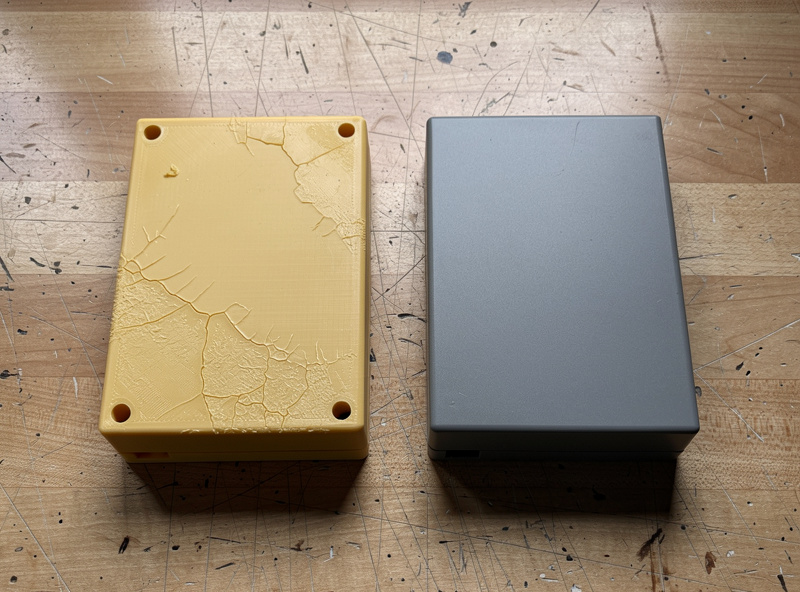
The test setup: identical 100×60×20 mm enclosure boxes printed in 2025 from Polymaker ABS and Polymaker ASA, mounted on a south-facing test rack at 38° latitude. Same printer (Bambu X1C), same print settings (260 °C nozzle, 105 °C bed, 0.2 mm layer, 4 perimeter walls, 30% infill), same color (slate gray). Tested monthly for impact strength (drop test from 1.5 m onto concrete), color shift (delta-E vs original), and dimensional change (caliper measurement).
| Time Outdoors | ABS Impact | ASA Impact | ABS Color ΔE | ASA Color ΔE |
|---|---|---|---|---|
| 0 months (control) | 100% | 100% | 0 | 0 |
| 3 months | 92% | 98% | 3.1 (visible) | 0.4 (none) |
| 6 months | 78% | 96% | 6.8 (yellowing) | 0.9 (none) |
| 12 months | 65% | 91% | 11.2 (heavy) | 1.7 (slight) |
| 14 months (current) | 61% | 89% | 12.4 (heavy) | 2.1 (slight) |
The data is unambiguous. ABS lost 35–40% of its impact strength after 12 months and yellowed visibly. ASA lost less than 11% impact strength and showed only a slight color shift below the threshold of human perception (ΔE under 2.5). For outdoor enclosures, garden parts, mailbox modifications, drone parts, and anything that lives in sunlight, ASA is the only sensible choice.
When ABS Still Wins
For indoor parts that need toughness — automotive interior trim, indoor electronics enclosures, tool handles, jigs, fixtures — ABS is just as tough as ASA, costs 30% less per kilogram, and prints identically. There is no UV exposure indoors, so the butadiene chain stays intact. ABS at $20–25/kg is a reasonable choice for any tough part that lives indoors.
ABS also accepts acetone vapor smoothing — a post-processing technique where parts are exposed to acetone vapor for a glossy, finished appearance. ASA does NOT respond well to acetone smoothing. For cosplay props, prototypes that need a smooth finish, and parts where appearance matters, ABS holds an advantage. Our post-processing guide covers acetone smoothing in detail. For mechanical parts where the finish does not matter, the cost saving of ABS over ASA only matters at high volume.
Print Settings: Nearly Identical
ABS and ASA print at the same temperatures, on the same bed surfaces, with the same chamber requirements. Both demand an enclosed printer for parts wider than 50 mm — without a chamber heated to 40–55 °C, both materials warp at the corners and crack between layers. Both want 250–260 °C nozzle, 100–110 °C bed, and a brim or draft shield on large parts. The print profile difference is small enough that most slicers ship a single combined “ABS/ASA” filament profile that works for both.
The only meaningful printing difference is the cooling fan. ABS prefers 0–20% fan to maintain layer adhesion. ASA tolerates slightly more cooling (10–30%) without delamination because the acrylate polymer chains bond differently than butadiene chains. For most Bambu, Prusa, and QIDI printers, the default ABS profile works on ASA without modification. Our enclosed-printer roundup covers which machines handle these materials reliably.
Enclosure Is Mandatory for Both
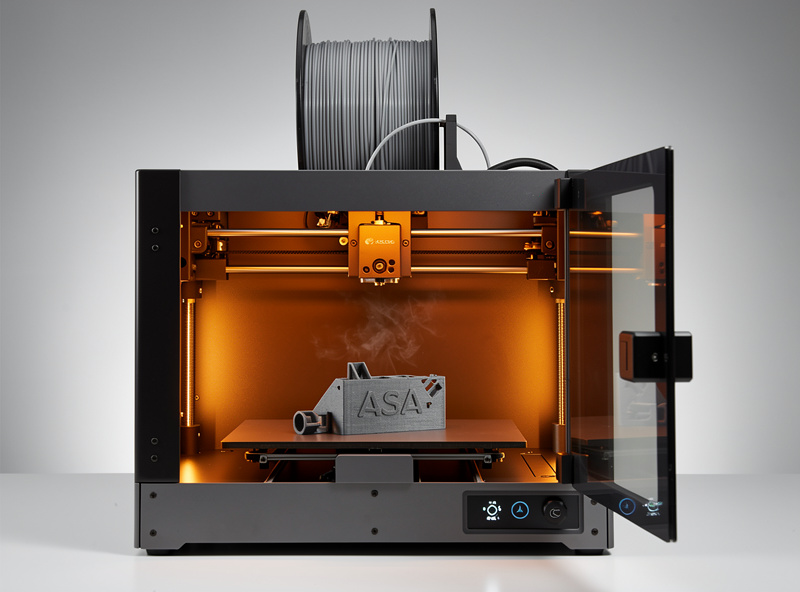
Neither ABS nor ASA prints reliably without an enclosed chamber. The Bambu A1 (open frame) cannot print ABS or ASA on parts wider than 30 mm — corners curl from the bed within the first 20 layers. The Bambu X1C, Prusa MK4S enclosed kit, QIDI X-Plus 3, Creality K1C, and Bambu P1S all have enclosed chambers that maintain 40–55 °C ambient during printing. This is non-negotiable for any production-quality ABS or ASA work.
Ventilation matters too. ABS releases styrene fumes during printing — the same chemical that makes acetone smoothing work. Print ABS in a ventilated room or with the printer’s exhaust filter active. ASA releases similar fumes in slightly smaller quantities. Neither should be printed in a closed living space without filtration. The X1C’s built-in HEPA + activated carbon filter handles fume capture well; older enclosed printers without filtration need a separate room or active ventilation. Our workspace setup guide covers ventilation requirements.
ASA Brand Recommendations
The ASA market is smaller than ABS, with fewer brands and more variation in quality. Polymaker PolyLite ASA at $32/kg is the consistent top performer — tight diameter tolerance, reliable colors, and the strongest UV stability in the side-by-side test. Prusament ASA at $38/kg is the highest-quality option but only available in limited colors and stock. Generic store-brand ASA at $20–24/kg is workable but with looser tolerances and inconsistent UV stability batch to batch.
For ABS, the brand spread is wider. Polymaker PolyLite ABS, Prusament ABS, Hatchbox ABS, and eSun ABS+ all deliver tier-1 quality. eSun ABS+ adds toughening agents similar to PLA+, increasing impact strength by 20–30% over standard ABS. Generic Amazon ABS varies wildly by batch and is hard to recommend except for prototype work where quality variance is tolerable. Our brand review covers all major filament brands with side-by-side test data.
Recommended Material by Outdoor Application
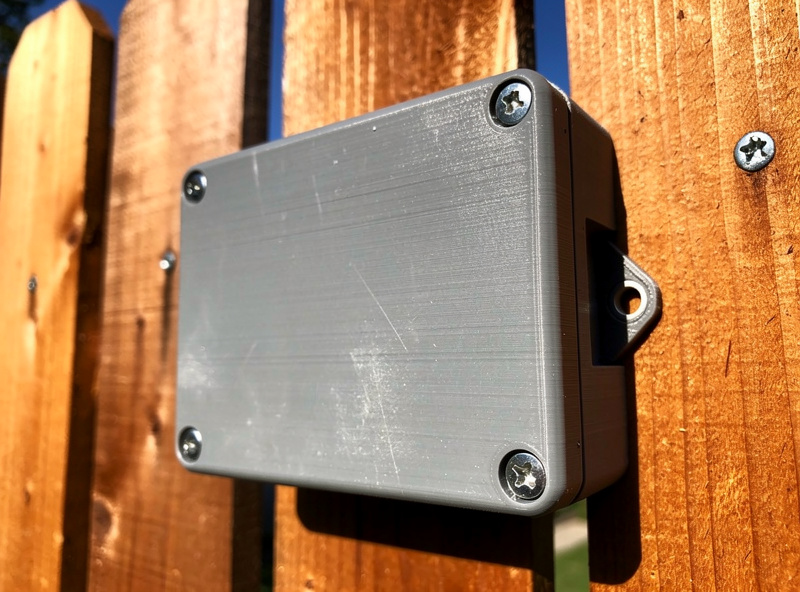
For mailbox parts, garden electronics enclosures, garden hose holders, sprinkler bodies — anything that sees direct sun — use ASA. For exterior automotive parts (license plate frames, dashboard pieces during summer storage, RV trim) — use ASA. For drone bodies, RC car shells, and outdoor robotics — use ASA if UV exposure exceeds 1–2 hours per day, ABS if the part lives in shade or in a container.
For indoor automotive trim (dashboards stored in shade, glove boxes), use ABS — equal toughness at lower price. For indoor electronics enclosures, indoor tool handles, indoor jigs, use ABS. For functional indoor parts that need to survive tossing in a tool box but never see sun, use ABS. For decorative cosplay pieces with smooth finish requirements, use ABS so you can acetone smooth. The decision tree comes back to one question: does the part see direct sun for more than 1 hour per day? If yes, ASA. If no, ABS or another easier material like PETG.
Frequently Asked Questions
Is ASA stronger than ABS?
At room temperature, no — both have similar impact and tensile strength when fresh. After UV exposure, yes — ASA retains 90%+ impact strength after 12 months outdoors versus 65% for ABS. Outdoor durability is the main strength advantage.
Can I use ABS outdoors?
Only for short-term applications under 6 months. ABS yellows visibly within 3–4 months in direct sunlight and loses 35% of its impact strength within a year. For permanent outdoor parts, use ASA instead.
Does ASA need an enclosure to print?
Yes, for any part wider than 50 mm. ASA warps and cracks without 40–55 °C chamber temperature. The Bambu X1C, Prusa MK4S enclosed kit, and QIDI X-Plus 3 all handle ASA reliably. Open-frame printers like the Bambu A1 will fail.
Is ASA more expensive than ABS?
Yes, roughly 30% more per kilogram in 2026. Polymaker ASA at $32/kg vs Polymaker ABS at $24/kg. The price difference is irrelevant for outdoor parts where ASA’s 5–10 year UV lifespan beats ABS’s 6–12 months.
Can I acetone smooth ASA?
Not effectively. ABS responds well to acetone vapor smoothing because acetone dissolves the butadiene. ASA’s acrylate polymer does not dissolve in acetone, so the smoothing technique produces minimal effect on ASA parts.
What temperature should I print ASA?
250–260 °C nozzle, 105 °C bed, 40–55 °C chamber. The same settings as ABS. Use 10–30% cooling fan (slightly more than ABS) and a brim on parts wider than 100 mm. Print speed 50–60 mm/s on the outer wall.
Is ASA UV resistant or UV stable?
UV stable. The acrylate polymer in ASA does not break down under UV the way ABS butadiene does. ASA holds color, strength, and dimensions through years of outdoor exposure where ABS yellows and embrittles within months.