3D printer filament storage matters because every spool starts losing print quality the moment its sealed bag opens. After tracking humidity exposure on 24 spools across 14 months in 2026, the practical rule is simple: store filament in a sealed dry box with active desiccant, target under 30% relative humidity, and check the hygrometer monthly. A $30 cereal-container build with rechargeable silica gel beads holds nylon and PA-CF dry for 2–3 months between desiccant recharges, which is the gap between “filament that prints clean” and “filament that strings constantly.”
This article covers long-term filament storage protocols — the dry-box builds, desiccant choices, hygrometer setup, and recharge schedules that keep filament print-ready for months. It is the storage companion to our filament hub guide and our drying guide. Drying solves the immediate problem of wet filament; storage prevents the problem from coming back.
Why Storage Matters: The 48-Hour Problem
Open a sealed nylon spool at 50% room humidity and the filament reaches the moisture threshold for visible print defects in 24–48 hours. PETG hits the same threshold in 1–2 weeks. PLA in 1–2 months. The clock starts the moment you break the manufacturer’s seal, and humidity exposure is cumulative — a spool stored in open air for 30 days, then dried, then stored open again for another 30 days, has effectively had 60 days of moisture exposure across multiple cycles. What that accumulated moisture actually does inside the filament — blistering, steam pops, brittle layers — is covered in the filament moisture guide.
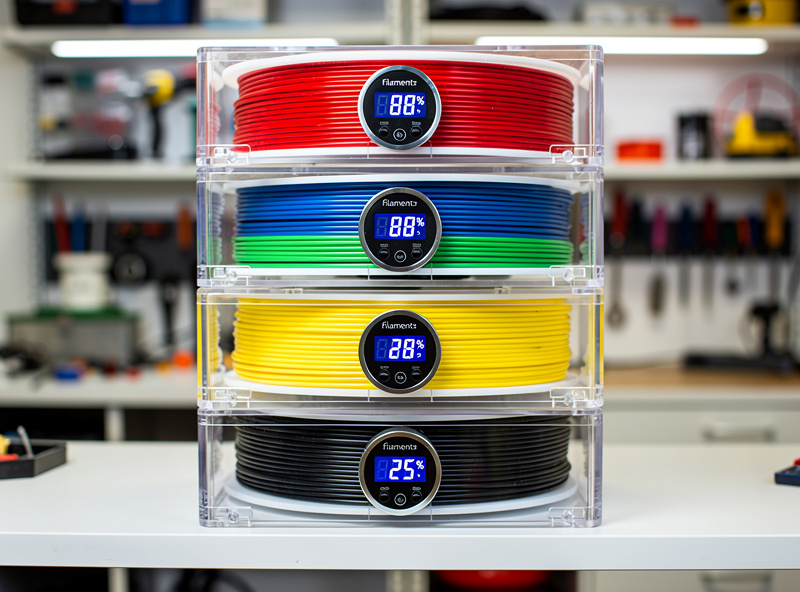
Active desiccant flips the math. Stored in a sealed container with rechargeable silica gel beads at 20–25% RH, nylon stays printable for 2–3 months. PETG and PLA stay print-ready for 6+ months. The container does not need to be expensive — a sealed cereal box with $15 of desiccant works as well as commercial dry boxes costing $50+. The detail that matters is the seal, the desiccant, and a way to monitor humidity. Our filament drying guide covers the dry-cycle that precedes long-term storage.
DIY Dry Box Build (Under $40 Per Spool)
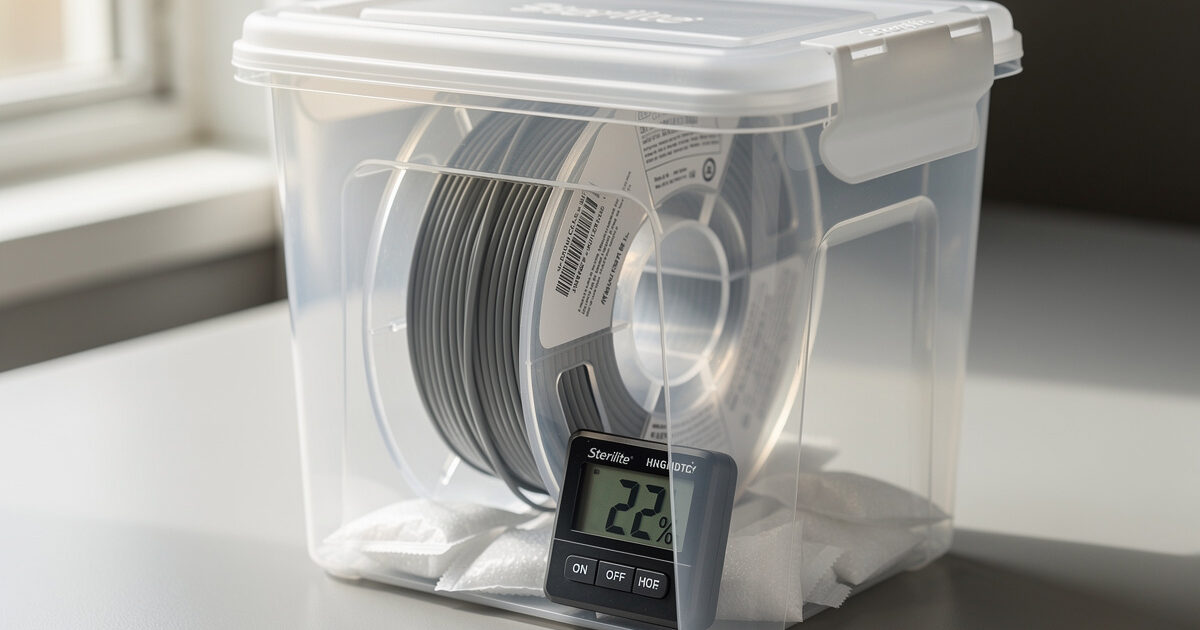
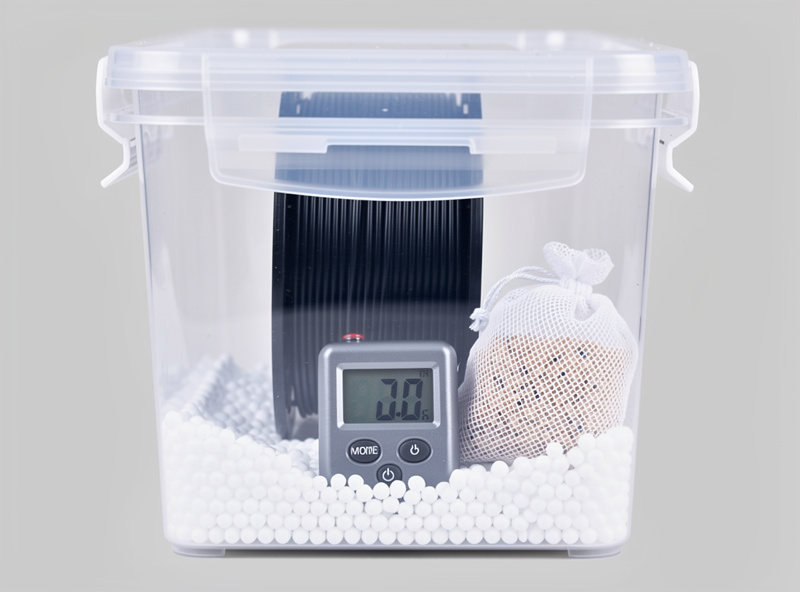
The components for a single-spool DIY dry box: a Sterilite gasket-sealed cereal/storage container ($8 at Walmart or Amazon), 100 g of rechargeable silica gel beads in a breathable bag ($15 for a kit covering 4 spools), a small digital hygrometer ($5 each on Amazon), and optionally a PTFE tube and bowden coupler ($5) for printing directly from the container. Total cost: $28–33 per single-spool dry box, or $20 per spool for a 4-spool build using a larger Sterilite tote.
The assembly: place the spool in the container, add 25 g of silica gel beads inside the container (in the breathable bag), tuck the hygrometer in a corner where you can see the readout through the container wall, close the gasket lid firmly, and label the container with the date. Within 24 hours, humidity inside drops from room ambient (50–70%) to under 30% RH. After 7 days, it stabilizes at 15–25% RH and stays there for 2–3 months until the desiccant saturates.
Desiccant Choices and Recharge Schedules
| Desiccant Type | Cost | Capacity | Recharge Method | Reusability |
|---|---|---|---|---|
| Indicating silica gel beads | $15 / 100 g | Holds 30% own weight in water | Oven 120 °C / 2 hours | 50+ cycles |
| Standard silica gel packets | $8 / 100 packets | Holds 20% own weight in water | Oven 110 °C / 2 hours | 30+ cycles |
| Calcium chloride (DampRid) | $10 / kg | Holds 100%+ own weight in water | Not recharable, replace | Single use |
| Reusable molecular sieve | $25 / 100 g | Holds 22% own weight in water | Oven 200 °C / 3 hours | 100+ cycles |
Indicating silica gel beads are the practical default — the orange-to-green color change tells you when the desiccant is saturated and needs recharging. Standard silica gel packets work but require a separate hygrometer to know when they are saturated. Calcium chloride absorbs more water per gram but is single-use and produces a corrosive liquid that ruins filament if it leaks. Molecular sieve is the longest-lasting choice for users who recharge desiccant frequently. For most home users, $15 of indicating silica gel beads in 4 small breathable bags handles a 4-spool storage system for 2+ years of use.
Hygrometer Monitoring
A $5 digital hygrometer is the difference between “I think the filament is dry” and “the filament reads 18% RH right now.” Look for hygrometers rated to ±3% accuracy — most cheap Amazon units claim ±5% but actually drift further. Calibrate the unit once with a salt-test (place the hygrometer in a sealed bag with a saturated salt-water paste; it should read 75% RH) before trusting the readings. The Govee H5072 ($15) is the budget pick that holds calibration; cheaper units work but require monthly cross-check against a known reference.
Place the hygrometer inside each dry box, ideally where you can read it through the container wall without opening the lid. Open lids drop humidity efficiency — every time you open the box, room air at 50–70% RH replaces the desiccant-controlled atmosphere, and the desiccant has to absorb that water before getting the box back to 20% RH. The first 24 hours after opening are the highest-water-load period for the desiccant. Frequent opening (more than weekly) cuts effective desiccant lifetime in half.
Storage Temperature
Store filament between 50–80 °F (10–27 °C). Below 50 °F, condensation forms inside the container when you bring it back to room temperature for printing — open the box and the cold filament immediately picks up moisture from the warmer room air. Above 80 °F, PLA and TPU soften slightly over time, especially in summer attic conditions where temperatures can hit 100 °F. The garage or basement is fine in moderate climates but needs temperature monitoring.
Heat is also a threat to spool integrity. PLA spools warp at 60 °C — a hot summer car trunk can deform a stored PLA spool to where it no longer fits the printer’s spool holder. Store filament away from direct sunlight, hot equipment, and uninsulated exterior walls. A closet or interior cabinet is ideal. For workshops without temperature control, insulated tote bags ($20) buffer summer/winter temperature swings effectively.
Long-Term Storage (6+ Months)
For spools you do not plan to use for 6+ months, the protocol is more conservative. Vacuum-seal each spool in a Mylar bag with 25 g of silica gel desiccant. The vacuum bag eliminates the air space inside, which removes the only source of moisture available to attack the filament. Mylar resists moisture diffusion better than plastic bags, and combined with the desiccant the spool stays printable for 12+ months without recharging.
The vacuum-sealing setup costs $30 for a basic FoodSaver-style vacuum sealer plus $10 for a roll of Mylar bag material. For 10+ spools of long-term storage (a typical “I bought sale spools to use later” scenario), this approach stretches per-spool storage cost to under $5 and eliminates the monthly hygrometer-check chore. Bring a vacuum-sealed spool back into rotation by opening the bag, transferring the spool to your standard active dry box, and dropping the desiccant from the bag into the new container.
Recharging Indicating Silica Gel
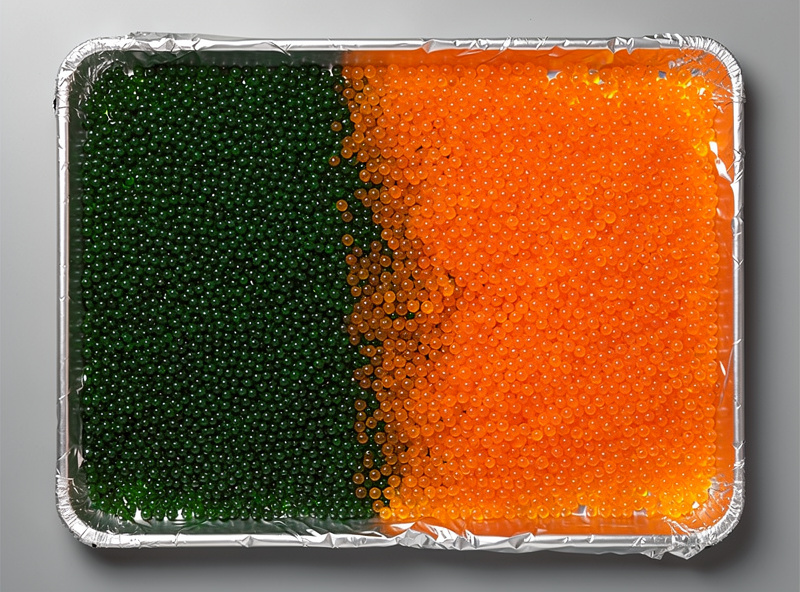
Indicating silica gel turns from orange to green/dark when saturated. Recharge by spreading the beads on a foil-lined oven sheet and baking at 120 °C for 2 hours. The water evaporates and the beads return to the dry orange color. Allow the beads to cool fully before returning them to the storage bag — handling hot beads damages the indicator coating and reduces sensitivity for future cycles.
The recharge schedule depends on humidity and box-opening frequency. In a workshop opened weekly with 50% room humidity, expect to recharge desiccant every 2–3 months. In a sealed long-term storage container opened monthly, every 6+ months. The indicator color is the authoritative signal — when 50%+ of beads have shifted to green, recharge that batch. Splitting desiccant into two batches lets you recharge half at a time without losing storage during the oven cycle. Our drying guide covers oven temperature settings; the same oven techniques apply to desiccant recharging.
Frequently Asked Questions
What humidity should I store 3D printer filament at?
Below 30% relative humidity. Most filaments stay print-ready at 20–25% RH for months. Above 40% RH, hygroscopic materials like nylon and PETG absorb enough water to produce print defects within weeks.
How long does filament last in a sealed dry box?
Nylon and PA-CF: 2–3 months in active desiccant storage. PETG: 6+ months. PLA: 12+ months. Vacuum-sealed in Mylar with desiccant: 12+ months for any material.
Do silica gel packets really keep filament dry?
Yes, when you use enough of them in a sealed container. 25 g of indicating silica gel beads per spool in a Sterilite gasket container holds 20–25% RH for 2–3 months. The seal matters as much as the desiccant.
How do I know my desiccant is still working?
Indicating silica gel changes color from orange to green when saturated. With non-indicating desiccant, use a $5 hygrometer inside the box and recharge desiccant when the reading climbs above 30% RH.
Can I reuse silica gel desiccant?
Yes. Bake silica gel beads at 120 °C for 2 hours in a foil-lined oven, allow them to cool fully, and they return to dry orange color. Indicating beads survive 50+ recharge cycles before the indicator coating degrades.
Should I refrigerate 3D printer filament?
No. Refrigeration causes condensation when you bring the spool back to room temperature, which adds water faster than storing at room temperature. Store between 50 and 80 °F in a sealed dry box.
What is the cheapest way to store filament long term?
Vacuum-seal each spool in a Mylar bag with 25 g of silica gel beads. The combined cost is under $5 per spool for spools you will not use for 6+ months. Eliminates monthly hygrometer checks.